
Canada’s agri-food system, valued at over $149 billion and employing some 2.3 million people, is a foundational engine of our national economy. However, the sector is also now navigating an era of major volatility. Market turmoil and fragmentation, climate change, geopolitical instability, demographic transition and huge technological shifts are all having interrelated impacts.
 One solution to boost the sector’s productivity and resilience amid these dynamics lies in accelerating the adoption of digital agriculture. This involves the use of tools such as AI, automation, satellite imaging, field-based sensors and data-driven platforms. Yet often overlooked is how doing so can also be a catalyst for addressing some of Canada’s broader areas of need.
Rather than being viewed as merely another economic sector, agriculture should be harnessed as a core strategic asset and pathway to Canada becoming a global technology powerhouse. If this change in mindset can gain traction among policymakers, both Ottawa and the provinces have a higher likelihood of achieving several other intersecting goals. Among them: building sovereign industrial capacity, driving productivity growth and fortifying supply chains.
Many of the concepts and ideas laid out in the AI For All strategy and the National Food Security Strategy — and the Defence Industrial Strategy — touch upon this possibility. The same is true for numerous provincial initiatives. Plus, meeting Canada’s obligations under NATO’s Article 3 on national resilience and civil preparedness.
Still, there’s a risk these ambitions go unfulfilled. Without concerted effort by different departments at different levels of government to affix greater importance to agriculture within Canada’s other nationbuilding priorities, the country will continue to underutilize one of its chief sources of innovation and competitive advantage in the digitized, 21st century global economy.
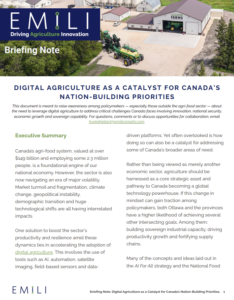
Read EMILI’s Briefing note: Digital agriculture as a catalyst for Canada’s nation-building prioirities to learn more. This document is meant to raise awareness among policymakers — especially those outside the agri-food sector — about the need to leverage digital agriculture to address critical challenges Canada faces involving innovation, national security, economic growth and sovereign capability.