
Spring 2026 brought record-breaking rainfall and severe winds to parts of Manitoba. In the aftermath of the season’s storms, producers across the province were faced with tough decisions about crop management and insurance.
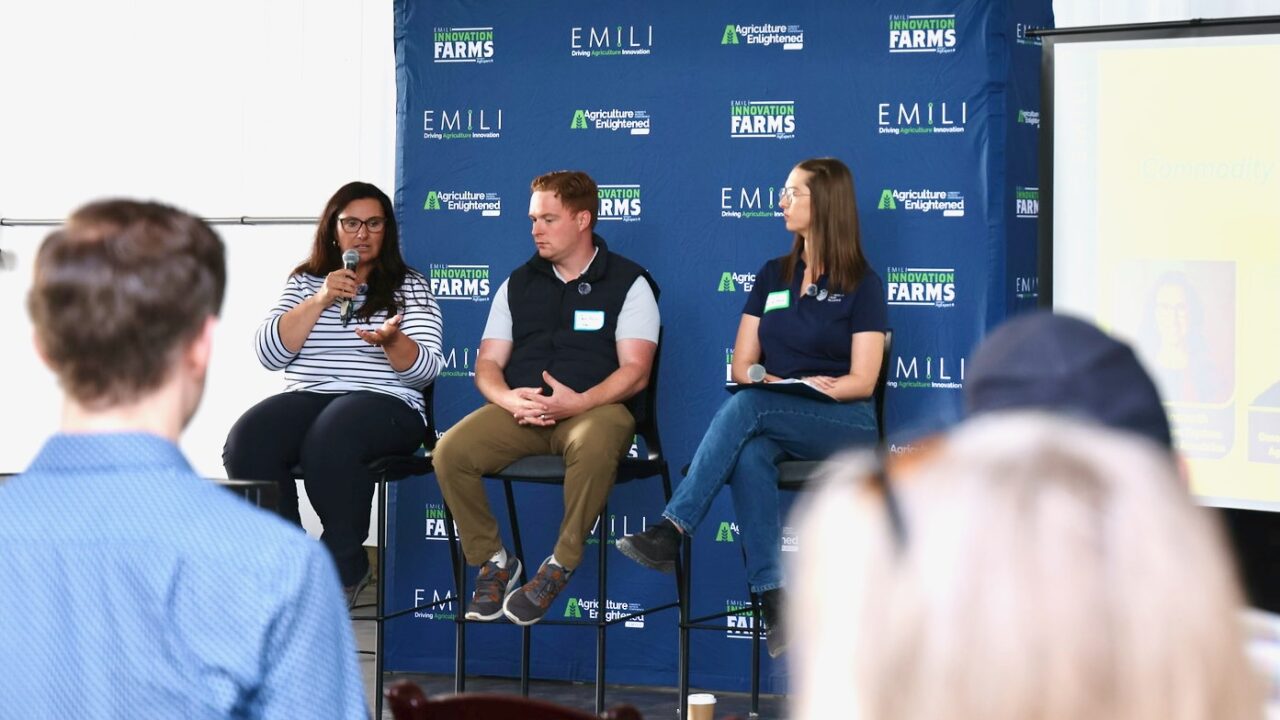
In response to this, EMILI invited the community to Innovation Farms powered by AgExpert in mid-August for a panel discussion about the influence of the season’s weather, and what crop management may look like on affected fields in the coming years.
The panel included representatives from Manitoba Crop Alliance (MCA), Keystone Agricultural Producers (KAP), and Keystone Potato Producers Association (KPPA).
Facing excess water and fields affected by wind, producers had to rethink their crop management decisions this year. At the outset of the discussion, Susan Ainsworth, general manager of Keystone Potato Producers Association, described the 2026 growing season as a roller coaster.
“There were some management decisions that had to change immediately when any of those weather events were happening,” Ainsworth said.
She explained that potato producers typically split-apply nitrogen to their crop, rather than applying it all at once, and that they rely on slow-release nitrogen products or fertigation.
“If you get 10 inches of rain, you’re probably not going to be running your pivot to apply some additional nitrogen. We did have some growers need to change plans part way through, and in some cases had to fly on granular product, which is not ideal.”
Ashley Ammeter, whole farm specialist with Manitoba Crop Alliance said the immediate impact of heavy rainfall had a major impact on farmers, and that impact extended throughout the entire growing season.
“In some cases we’re looking at significant nutrient losses. How am I going to top up those nutrients? Am I looking at in-season application?” Ammeter said.
“[Then there’s] weed control. That gets complicated when your field is under water. Those drowned out spots, how do I manage those? Are they full of weeds? Can I get in and mow them? Do I have to plant a cover crop? So it’s not just the immediate impact of that event, it’s also the long term, season-long impact of these events that cause farmers to have to rethink consistently.”
Ammeter added that with excess moisture comes increased disease risk, pointing to higher leaf disease in wheat this season compared to other seasons. This has required producers to examine, and in some cases adjust, the timing of fungicide application.
Severe weather prompts producers to examine current policies and programs
Amidst changing plans for crop management, Colin Hornby, former general manager of Keystone Agricultural Producers, said that in the wake of severe weather events, his organization received many questions from producers about what supports are available to them.
“We’re making sure that producers have that information available, through MASC (Manitoba Agricultural Services Corporation), and making sure that if you need someone to come in and assess, that you’re not doing anything with that field before you get that assessment done,” said Hornby.
When it comes to the impact of policies and other initiatives in the province, Hornby said that this season highlighted the importance of examining whether current programs work for producers and manage the risks that producers face. He noted that raising these questions is especially timely, as Canada’s Next Policy Framework for agriculture is currently being negotiated and will be released in 2028.
Supports offered to farmers impacted by severe weather range from financial assistance programs administered by the provincial and federal governments, to mental health supports through Manitoba Farmer Wellness and klinic.
Wind and water cause concerns about soil health, weed movement
While producers have had to change course this year to get the most out of their crops, the panelists expect that this season’s weather will have repercussions into 2027 and beyond. Ammeter pointed to the fierce winds that occurred in May, noting that they caused significant erosion of Manitoba’s soil.
Manitoba’s Soil Erosion Guide states that the maximum tolerable loss of topsoil on a well-developed soil is just 0.75 millimetres. Soil is most susceptible to wind erosion during early spring and after fall tillage. Ammeter said there were areas in Manitoba that experienced much more erosion than what is tolerable.
“That loss of top soil has big implications. We’re talking loss of nutrients, but we’re also talking maybe exposure of the sub soil, which has different pHs. That top soil has a huge amount of organic matter that has implications in terms of water holding capacity and maintaining soil structure,” Ammeter said, adding that soil will require extra management in 2027 and many years into the future.
“That top soil took many hundreds of thousands of years to develop, and it’s going to take us many years, for lack of a better word, to replace.”
Ammeter suggested landscape restoration, extra fertility, using minimum tillage practices, thinking about higher residue crops and cover crops, and removing rather than bailing straw as potential options to remediate soil loss.
Both Ammeter and Ainsworth shared concern about the amount of excess water from this season and what that will mean for future growing seasons. Ammeter cited the movement of weed seeds, including waterhemp, an aggressive, highly adaptable weed that spreads in flood waters and poses challenges to crop production in Manitoba.
“If weeds got away from us this year because we couldn’t get into the field to spray or because we had those drowned out areas, that might take a little extra consideration in the next few years because we had extra weed seed return to the soil.”
Ainsworth noted that compaction, which can hinder water infiltration, soil air movement, seedling emergence and root growth causing yield loss, could be an issue for potato producers in coming years.
“Compaction is really important in potatoes, when it’s a crop that you’re growing in soil. I do think there are going to be implications,” said Ainsworth.
Manitoba a hub for agriculture research, innovative solutions and strong talent
While the 2026 growing season was a challenging one for many producers across the province, the panelists said there is still plenty to be optimistic about. For Hornby, it’s the organizations and spaces that highlight agriculture technology and research.
“We have this site here, Innovation Farms, which is a great place,” Hornby said.
“We have the Glenlea Research Station with the Farm and Food Discovery Centre. We hear consistently when we bring people from other parts of Canada to these places, that they are examples of what they want their province to do.”
Ainsworth spoke to the way that challenges brought on by natural events lead to improvements.
“How do we stay viable? I think there are a lot of really awesome things that Manitoba has going for it, and organizations such as KAP that are there to help support Manitoba agriculture. I think it’s a combination of those things, and the growers working together and identifying what we do have available at our disposal to work with and make the most out of.”
For Ammeter, the people working in the agriculture industry are the key to the future of agriculture in Manitoba.
“There are really creative and amazing people in our industry who are looking at these challenges and saying, ‘What can we do about them?’ And that gives me a huge amount of optimism.”
EMILI hosts multiple events and demonstrations throughout the season to showcase new agricultural technologies, expand innovation opportunities, and increase understanding and adoption of digital tools. The next opportunity to hear from experts on a range of topics is Agriculture Enlightened, Canada’s Agtech Conference, taking place November 5, 2026 in Winnipeg.