
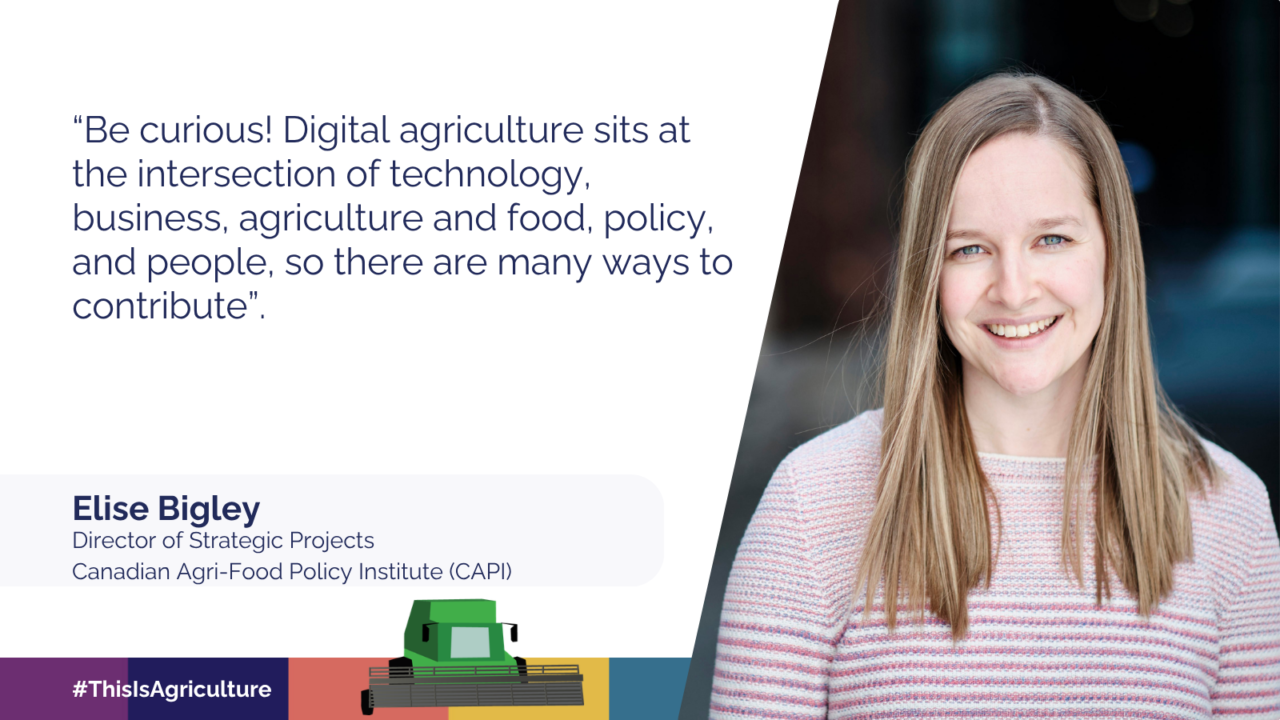
Elise Bigley (BA, MA) joined the agriculture industry after a background in history and research. After her initial work with the Canadian Agri-Food Policy Institute (CAPI), her job continued to expand and change. As Elise got more involved in various projects, her passion and interest in agriculture continued to grow. She now holds the role of Director of Strategic Projects, where she helps to lead many projects across CAPI from idea to delivery. Read more about Elise’s journey into agriculture below!
Describe your job or product in one sentence.
I help lead our projects from idea to delivery; varying from reports and webinars to our annual conference, in-person and virtual dialogues, and large-scale initiatives. In practice, this means I have my hands in almost everything we do!
Where did you grow up? Was it an agriculture or urban environment?
I grew up in New Westminster, BC in a very urban environment.
What was your dream job when you were a kid?
My dream job varied quite a bit over the years, from wanting to be a teacher to wanting to be a diplomat and explore the world. What has stayed consistent is that I’ve always been interested in learning, communicating, and connecting people and ideas. That is something I really appreciate about my current role at CAPI: the opportunity to take complex research and policy questions and translate them into something people can understand and engage with.
What was your first job in the agriculture or agri-food sector?
I am technically still in my first job in the agriculture and agri-food sector! I’ve been with CAPI for almost eight years, although my role has changed quite a bit during that time, so it doesn’t always feel like the same job.
What brought you to your current role?
I came to agriculture somewhat unexpectedly. My background is in history and research. I was initially hired at CAPI to update our mailing list. I slowly got more involved in other projects and was hooked!
How does digital agriculture or agtech play a role in your current job?
Digital agriculture has become an increasingly important part of my work at CAPI. We’ve been working on a file for a few years now, including two reports, and are now taking the next step with the CAPI-EMILI Digital Agri-Food Policy Forum. The Forum is about bringing together the people working across digital ag, from producers and tech companies to researchers, investors and government, to establish a clearer, shared understanding of key challenges and opportunities in digital agriculture.
What advice would you give someone considering a career in digital agriculture?
Be curious! Digital agriculture sits at the intersection of technology, business, agriculture and food, policy, and people, so there are many ways to contribute. You don’t need to be a tech developer or data scientist to have an impact. Understanding the problems that the sector is trying to solve and being able to connect the right people and ideas is just as valuable.
What’s something that surprised you when you started working in digital agriculture?
What surprised me most was that the biggest challenge isn’t necessarily developing the technology – we are a country full of great ideas and promising technologies! The harder question is how we get those innovations adopted at scale. Issues like ROI, capital, connectivity, interoperability, skills and trust are just as important as the technology itself.
Why do you think digital agriculture is important, now more than ever?
Canada’s agri-food sector is facing pressure from almost every direction, and uncertainty is our new norm. Digital tools won’t solve all of these challenges, but they can give producers and businesses better information, boost efficiency, and provide new ways to manage risk. Digital agriculture can be an important part of a producer’s risk management toolbox. For Canada to remain competitive, we need to move beyond seeing digital agriculture as a “nice-to-have” and recognize it as an important part of the sector’s future.
How would you describe digital agriculture to someone outside the sector?
I would describe digital agriculture as using data and technology to make better decisions about how we grow, process, and move food. That can mean anything from sensors and satellite imagery that help a farmer understand what’s happening in a field, to robotics, AI, and data systems that improve how food is produced and processed. At its core, it’s about using technology to make the agri-food system more competitive, productive, and resilient.
This profile is part of EMILI’s This is Agriculture series, highlighting talented and diverse individuals across the digital agriculture sector. While individuals working in agriculture come from a variety of backgrounds, they share a common interest in growing and strengthening Canadian agriculture to ensure an environmentally and economically sustainable future for generations to come.