
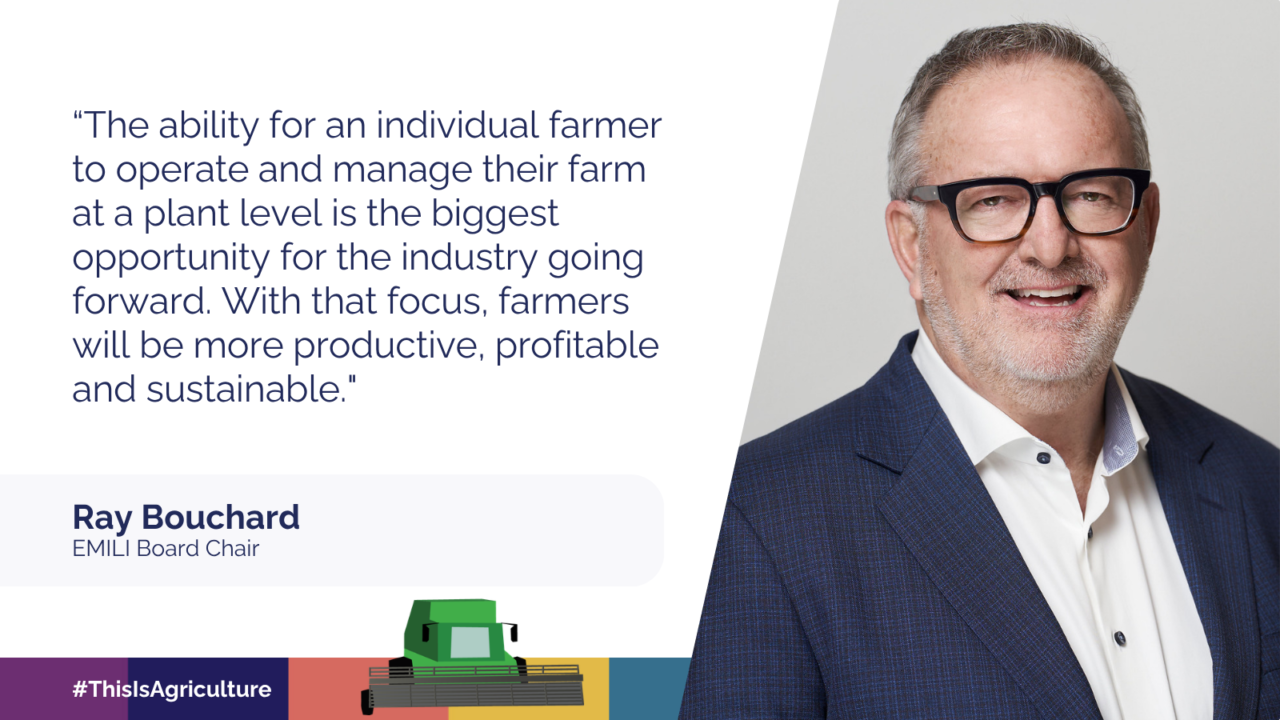
Ray Bouchard has worked in the agriculture industry for 46 years in a career that has spanned sales roles in agriculture manufacturing and distributing, and leadership roles including more than a decade as CEO of Enns Brothers. For more than ten years, Ray has contributed his entrepreneurial spirit and strategic expertise as EMILI’s board chair. Here, Ray shares what makes him passionate about agriculture, and his vision for EMILI’s future success.
Describe your role as EMILI’s board chair.
In the early days of EMILI, I was more involved on the operational side of the organization but now that we’re 10 years in as an organization, I am focused on EMILI’s long-term strategy.
Where did you grow up? Was it an agriculture or urban environment?
I grew up just west of Winnipeg in Elie, Manitoba. You could call it a bedroom community of the city, but also it was an agricultural community.
What was your first job in the agriculture or agri-food sector?
I had a chance when I was in my teens to work for a couple of farm operators. I did everything there from working as a truck driver, to operating a combine. I still remember the long hours and working well into the night with floodlights loading grain because you needed to get the crop off. It gave me an early understanding of the challenges producers face putting a crop in and taking it off.
What brought you to your role with EMILI?
After about 19 years working in the agriculture manufacturing and distribution sectors, I had the opportunity to join Enns Brothers in 1999. I’ve spent 27 years with Enns Brothers – I joined them as a partner and general manager in their Portage la Prairie operation, and from there I moved into sales management, and then ultimately worked my way into the CEO role about 11 years ago. I’ll be retiring from my role as CEO in October 2026.
In 2016, a company focused on machine learning moved to Winnipeg from Toronto. They were focused on going to market with machine learning intelligence around the ability to identify pathogens. They were looking for some investors in the province, and they approached me, as a partner at Enns Brothers, with an opportunity. They were doing work in the pathogen space, but in early conversations, we talked about agriculture, and how there was going to be an opportunity within agriculture around machine learning and AI. As a leader in the organization, I’ve always been focused on what’s coming, and how we can strategically position ourselves. People were having conversations about setting Manitoba up as a centre of excellence as it related to machine learning and AI. I liked the concept, and I said “I’m in.”
What makes you passionate about your work?
There is always something new, and there is always opportunity. For me, it was never an eight-to-five role or responsibility. It was around engaging with more people, more relationships, networking. Quite often I would see individuals who had lots of thoughts about what was wrong, but nobody ever spent a lot of time talking about “how can we fix this?” And so, very early on, I thought, “Well, if I can find a way to participate in and do that, then I think there’s value to that.” I think that’s kind of what drove me.
I started in construction, and I still remember in those couple of years before I moved into agriculture, dreading getting up in the morning and going to work. From the day I started my first full-time job in agriculture to today, I can count on one hand the number of days that I’ve said, “Oh boy, do I have to go into work again today?” So I think that is pretty telling about my journey in agriculture and how much I’ve enjoyed it.
Why do you think digital agriculture is important now more than ever?
The term “digital agriculture” is really just about the modernization of agriculture and the use of new tools and technologies. It’s important today because the cost structure and the ability to run profitable, sustainable organizations has really changed over the last number of years, and unless you’re prepared, and unless you integrate and adopt new technologies and new ways of doing business, I think you’ll get left behind. You risk no longer being relevant and potentially losing your business
If you think about something as simple as agronomy, at a farm level, there are a number of new organizations or companies and tools that allow a farmer to actually have their own digital agronomist. Those are the kind of tools that are manifesting. I think the role for EMILI is we’ve really narrowed in on innovation, and I would say the application of new tools and technology – how do we continue to focus on that, structure ourselves so that we can add value to the industry, as it relates to both innovation and the integration of new tools and technology.
What is one of the most interesting things you see happening in digital agriculture right now?
Tools are now in the marketplace to inform where you plant your crop, where you space it, what depth you put it into, how you monitor it, how you finance it, and how you insure it. The ability for an individual farmer to operate and manage their farm at a plant level is the biggest opportunity for the industry going forward. With that focus, farmers will be more productive, profitable and sustainable.
At EMILI, we have the vision of Canadian Agriculture leading the world through transformative innovation. What does that look like to you?
Success, from our perspective, would be the continued buildout of the AIVA Network, which EMILI formed in partnership with Farm Credit Canada and Wabash Heartland Innovation Network. That touches all sectors of agriculture; from broad acre crops into livestock, into fruits and vegetables. I think there’s a vision to do that, but it’ll take a little bit of time. I think the broader inclusion of all sectors of agriculture into the AIVA Network, the buildout of the partnership and within that, attracting international investment into Canada, will be another key measure of success.
This profile is part of EMILI’s This is Agriculture series, highlighting talented and diverse individuals across the digital agriculture sector. While individuals working in agriculture come from a variety of backgrounds, they share a common interest in growing and strengthening Canadian agriculture to ensure an environmentally and economically sustainable future for generations to come.