
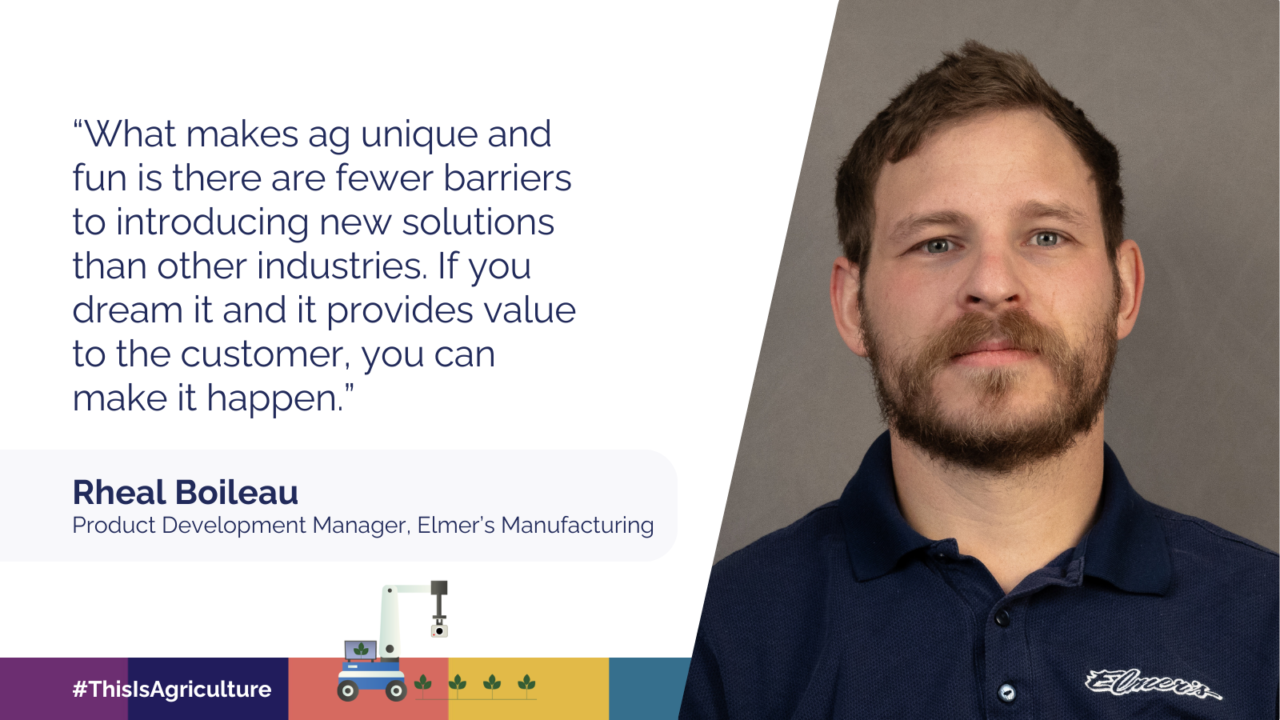
Rheal Boileau is a Product Development Manager at Elmer’s Manufacturing. Growing up on a cattle and hay ranch in southeastern Manitoba, Rheal learned the ropes of agriculture from a young age. He pursued a degree in engineering, and now guides the direction of product development at Elmer’s, ensuring products support the company’s vision of delivering innovative agricultural solutions for maximizing farming potential to feed the world.
Where did you grow up? Was it an agriculture or urban environment?
I grew up in Southeastern Manitoba on a cattle and hay ranch.
What was your dream job when you were a kid?
That is not something I recall. Probably a space cowboy or rock guitarist or space rock guitarist.
What was your first job in the agriculture or agri-food sector?
Guarding gates during feeding was probably my first productive contribution in the agriculture sector, which expanded into herding cattle, fencing and haying as I grew up.
What brought you to your current role?
I pursued an engineering degree because my brother became an engineer, and people told me I wasn’t as smart as my brother. Working in agriculture was always an easy fit for me, as I understood the problems faced by farmers, and it allowed me to solve the issues I experienced as a child for more than just one farm.
Elmer’s approached me during my work on a project they had submitted to the university where I was studying. Elmer’s has continued to grow as a company and the R&D department has grown proportionally. The larger amount of development staff necessitated my current role as a centre point to maintain a tighter vision and keep the group rowing the boat in the same direction.
How does digital agriculture or agtech play a role in your current job?
Developing solutions for growers is our focus at Elmer’s, and as technology has expanded, and growers’ needs have evolved, more of our products have value from digital solutions. My role is to keep solutions flowing to customers. Our software team is approximately half of our R&D staff, which is the area that has grown the most in the last decade.
What advice would you give someone considering a career in digital agriculture?
Spend time in agriculture, find the customers’ pain points within the value chain, and start dreaming of solutions. It’s important to first be problem-focused instead of solution-focused. Sometimes people are so focused on solutions when they don’t understand the problem. It’s a pretty important skill to be able to bridge the gap from the problem to the customer’s value prior to tackling the solutions.
What’s your favourite part about working in digital agriculture and agri-food?
What makes ag unique and fun is there are fewer barriers to introducing new solutions than other industries. If you dream it and it provides value to the customer, you can make it happen. The solution space for digital agriculture is still in the wild west phase where the optimal solutions are still undiscovered. This provides an immense opportunity to try more out-there ideas to create value for growers.
Why do you think digital agriculture is important, now more than ever?
Optimization of mechanical equipment for agriculture has been in progress for as long as humans have cultivated crops. The potential gains from optimizing in the digital space with the technologies available today are immense, and costs relating to these technologies are becoming more accessible daily. A great example of this can be seen in the work Elmer’s Manufacturing is doing with EMILI at Innovation Farms to test and validate the capabilities of the Hive Motherbin to optimize harvest and improve efficiency.
What’s the most interesting thing you see happening in digital agriculture right now?
Autonomy is finally starting to feel within reach. Recent releases like JCA Technologies’ OutRun and John Deere’s Predictive Ground Speed Automation are showing that we’re starting to figure out the pieces that were preventing autonomy from being used on a larger scale. The steps to autonomy are littered with automation and the more we can automate the closer we get. These two projects provide automation that is commercially available to customers and are designed in ways that can produce positive returns to customers without large investments.
This profile is part of EMILI’s This is Agriculture series, highlighting talented and diverse individuals across the digital agriculture sector. While individuals working in agriculture come from a variety of backgrounds, they share a common interest in growing and strengthening Canadian agriculture to ensure an environmentally and economically sustainable future for generations to come.